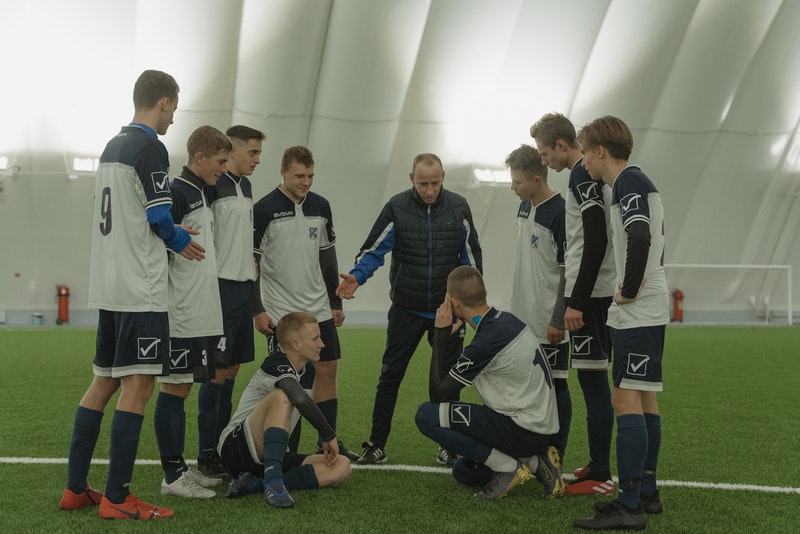
Most parents sign their children up for soccer to keep them active. The physical benefits are real, but many families are surprised by how much a team teaches about getting along with other people. Every practice puts a child in a group with shared goals, clear rules and an adult guiding them. That setting is ideal for practicing three social skills children need for the rest of their lives: communicating, fitting into a group and standing up for themselves.
1. Communicating
Social success starts with being able to talk to people clearly and appropriately. That covers simple things, like remembering names, and harder ones, like giving and receiving a compliment or explaining what you need. Soccer asks for all of it. A player has to call for the ball, tell a teammate a defender is coming, listen to the coach and respond to a captain's instructions, often in a few seconds.
The first step is surprisingly basic: learning teammates' names and using them across the field. From there, players learn short, useful calls such as "Man on," "Time" and "Switch," and they learn that tone matters. A sharp shout after a mistake makes the next pass worse; a calm "Next one" helps a teammate reset.
What coaches can do: run small-sided games where the ball can only be passed to a player whose name is called first. Children who rarely speak up quickly find a reason to.
What parents can do: ask your child about teammates by name after practice. It shows that relationships on the team matter as much as goals.
2. Being Part of a Group
Not every child knows how to join a group. There is a quiet negotiation involved: working out the unwritten rules, finding a role and being accepted by the others. Children have to learn give and take, and they have to understand that not every member of a group can lead. Some ideas will be welcomed and some will not.
A sports team gives that process a clear structure. The rules of the game, the positions and the coach's expectations show children how they fit in. A defender learns that the team depends on them even when they never score. A substitute learns to support teammates from the bench. Over a season, players discover that the group does better when everyone accepts a role.
What coaches can do: rotate small jobs such as collecting cones, leading a warm-up or choosing a team cheer, so every child has a way to contribute beyond playing time. Our guide on becoming a team leader has ideas for older players who want more responsibility.
What parents can do: encourage your child to arrive a little early and stay a little late. Much of team bonding happens in those unplanned minutes.
3. Standing Up for Yourself
Learning to assert yourself is one of the hardest social skills for a child. Some children are easily pushed aside, while more aggressive children need to learn that there are better ways to make a point than shouting or pushing. The goal is assertiveness without hostility, and a team game is a safe place to practice it.
Adam McAllister from Champion Soccer says "Team sports such as football (soccer) or rugby can help build a child's confidence and prepare them for later life. Some of my longest friendships are with those I met on the field."
On a team, children can try out different ways of speaking up with real but small stakes: asking for the ball, disagreeing politely with a teammate's idea, or telling a coach they would like to try a new position. Practice is a good place to learn the difference between assertiveness and aggression, which matters most for confident children who risk becoming bossy and for shy children who rarely say what they want.
What coaches can do: praise players who speak up respectfully, and step in quickly when a child is being talked over or picked on. If a team leader is becoming controlling, our article on a team captain going too far may help.
Skills That Carry Over Off the Field
The habits children practice on a team show up in other parts of life. A player who has learned to call for the ball is more likely to ask a question in class. A child who has sat on the bench and still cheered for teammates understands patience and loyalty. Working through a disagreement about who takes a free kick is practice for group projects at school and, later, for teamwork at a job.
Teams also mix children who might never meet otherwise: different schools, neighborhoods and backgrounds. Learning to get along with people who are not already your friends is one of the most useful things a young player can take from the sport.
Handling Conflict Between Teammates
Disagreements are normal on any team. Two players want the same position, someone feels left out of passes, or a joke goes too far. These moments are chances to practice social skills, as long as an adult helps the children work through them instead of ignoring them or settling everything immediately.
- Let each child explain what happened without interruption.
- Help them name how they feel and what they want.
- Ask them to suggest a fair solution before offering one.
- Check in at the next practice to see whether the fix worked.
A Simple Team-Building Game
This short activity works at the start of a season or with a group that does not yet know each other well.
- Set up a square about 20 yards wide with one ball for every three players.
- Players pass and move inside the square, calling the receiver's name before every pass.
- After two minutes, add a rule: a player must also say one word of encouragement after receiving.
- Finish with a small-sided game in which a team scores only after all of its players have touched the ball during the attack.
The game builds names, talking and inclusion into normal soccer play, so nobody feels singled out. For more games, see our soccer practice games hub.
How the Skills Grow With Age
Younger children: the focus is on sharing the ball, taking turns and learning names. Coaches should expect a lot of chasing and very little passing, and that is fine.
Middle childhood: players begin to understand positions and roles, and friendships within the team become important. This is a good age to talk openly about how to treat teammates after a loss.
Teenagers: leadership, conflict and team culture come to the front. Older players can help set team rules, mentor younger players and learn to handle disagreements without a coach stepping in every time.
Questions to Ask After Practice
A few open questions on the way home help children notice the social side of the game without turning it into a lesson:
- Who did you pass to the most today?
- Did anyone help you, or did you help someone?
- Was there a moment when you had to speak up?
- Is there a teammate you would like to get to know better?
If Your Child Finds Teams Hard
Some children find the social side of team sports stressful. For them, a smaller group, a friendlier recreational team or a sport with more individual time may be a better starting point. Talk with the coach about ways to ease them in, such as pairing them with a patient teammate. If shyness or anxiety is affecting your child beyond sports, it is worth speaking with their pediatrician or school counselor.
Common Mistakes
- Assuming social skills will develop automatically, without any adult guidance.
- Focusing so much on winning that quieter players never get a chance to contribute.
- Stepping in to solve every disagreement between teammates instead of coaching children through it.
- Letting the same few confident players dominate every drill and every conversation.
Team sports give children a weekly place to practice talking, belonging and speaking up, with friends around them and an adult to guide them. Parents and coaches who pay attention to those lessons help children carry them off the field. Parents looking for their own role on the team can start with our tips for sports parents.